
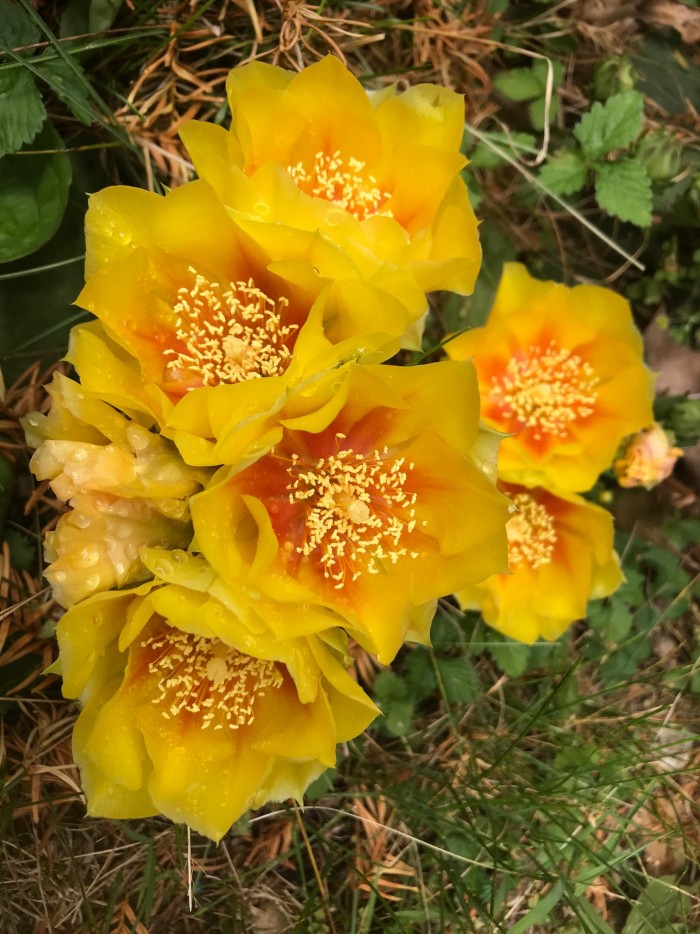


- [내 마음의 隨筆] 꼬라지는 타고나는 것이 아니라, 길들여지는 것이다 - 1 of 21862026.01.05
- [내 마음의 隨筆] 꼬라지는 타고나는 것이 아니라, 길들여지는 것이다 - 2 of 21172026.01.05
- [An Essay from My Heart] Temper Is Not Inherited — It Is Tamed1392026.01.05
- [내 마음의 隨筆] 崔岦의 一體八役과 人工知能 - 2 of 3 1232026.01.11
- [내 마음의 隨筆] 崔岦의 一體八役과 人工知能 - 1 of 3 1382026.01.11
[An Essay from My Heart] Temper Is Not Inherited — It Is Tamed
2026.01.05Everyone’s temper slips out of alignment several times a day.
Morning irritation.
Anger sparked by a single careless word.
Unexplained fatigue, sudden cynicism.
The problem is not that such moments arise.
The problem is how we handle them.
How one manages one’s temper—one’s inner posture—quietly but decisively shapes the course of a life.
Guided by methods long tested and verified around the world,
let us walk—slowly—through ten ways of taming our temper.
1. Name the Emotion, and Half the Work Is Already Done
When anger rises, instead of saying, “I’m angry,”
try saying, “I feel a mixture of disappointment and anger right now.”
Neuroscience shows that the moment an emotion is accurately named,
activity in the amygdala—the brain’s alarm center—begins to subside.
This is known as affect labeling.
“An emotion that is named is no longer in control.”
— UCLA Affective Neuroscience
Matthew Lieberman, UCLA
2. Temper Begins in the Body—So Start with the Body
Often, a single deep breath works faster than years of moral training.
Inhale for four seconds, exhale for six—three times is enough
for the nervous system to receive the signal: there is no danger.
This is a globally validated method of activating the parasympathetic nervous system.
“Breathing is the most direct message we can send to the brain.”
— Harvard Medical School
Harvard Health Publishing
3. Pause for Six Seconds Before Reacting
The stress hormone adrenaline peaks and begins to decline after about six seconds.
Fail to endure those seconds, and words spill out.
Endure them, and you remain human.
“Delayed reaction is the beginning of civilization.”
— Daniel Kahneman
Thinking, Fast and Slow
4. When Your Temper Is Off, Postpone Judgment
Most conclusions reached in a bad mood are wrong.
Psychology calls this mood-congruent judgment.
What feels unquestionably right today
often appears inexplicable tomorrow.
American Psychological Association (APA)5. The Moment You Try to Win, Your Temper Loses
The instant you feel the urge to defeat the other person,
emotional control has already slipped away.
In international negotiation theory, this is called an ego threat response.
“In a conversation aimed at winning, there are no winners.”
— Harvard Negotiation Project
Fisher & Ury, Getting to Yes
6. Lower Your Voice, and Your Thoughts Will Follow—Calmly
Lowering your vocal tone reduces neural arousal.
This technique is actively used in police, military, and diplomatic training.
FBI Behavioral Science Unit
7. The Words “Always” and “Never” Send Temper Into Overdrive
“You always do this.”
“This will never work.”
These are not facts—they are emotional exaggerations.
Cognitive Behavioral Therapy identifies them as classic cognitive distortions.
Aaron Beck, Cognitive Therapy
8. Temper Grows at Night and Shrinks by Morning
Sleep deprivation dramatically weakens emotional regulation.
The American Academy of Sleep Medicine identifies it as
one of the leading causes of emotional control failure.
American Academy of Sleep Medicine
9. Those Who Master Their Temper Change Their Inner Dialogue
Instead of saying, “Why am I like this?”
try saying, “I’m just not in good condition right now.”
This practice is known as self-compassion,
a globally validated method for emotional recovery.
Kristin Neff, University of Texas
10. Do Not Try to Eliminate Temper Completely
The resolution to live like a flawless sage rarely lasts.
Modern psychology and both Eastern and Western philosophies agree:
“The problem is not anger itself, but our resistance to it.”
— Marcus Aurelius / Acceptance and Commitment Therapy (ACT)
Stoic Philosophy & ACT Therapy
Those Who Tame Their Temper Damage Their Lives Less
People who manage their temper well
are not necessarily smarter—
they are simply able to respond a little later.
If even once a day you can notice,
“Ah, my temper is rising now,”
then that day is already a success.
Because temper is not something to eliminate,
but a companion to be gently trained.
January 5, 2026
At Sungsunjae (崇善齋)
— Solti
한글 번역:


-
 잊을 수 없는▶⑤◀고마웠던 분들
두 분 모두 믿음이 넘치는 신앙인으로살아 오셨는데 보통 신자로서의 삶이아니라 외부 재속 회원으로서 왕성한신앙생활들을 영위하여 오셨다는 것!어쩌다 활동에 임하다 보니 두 분의명성(…
잊을 수 없는▶⑤◀고마웠던 분들
두 분 모두 믿음이 넘치는 신앙인으로살아 오셨는데 보통 신자로서의 삶이아니라 외부 재속 회원으로서 왕성한신앙생활들을 영위하여 오셨다는 것!어쩌다 활동에 임하다 보니 두 분의명성(…
-
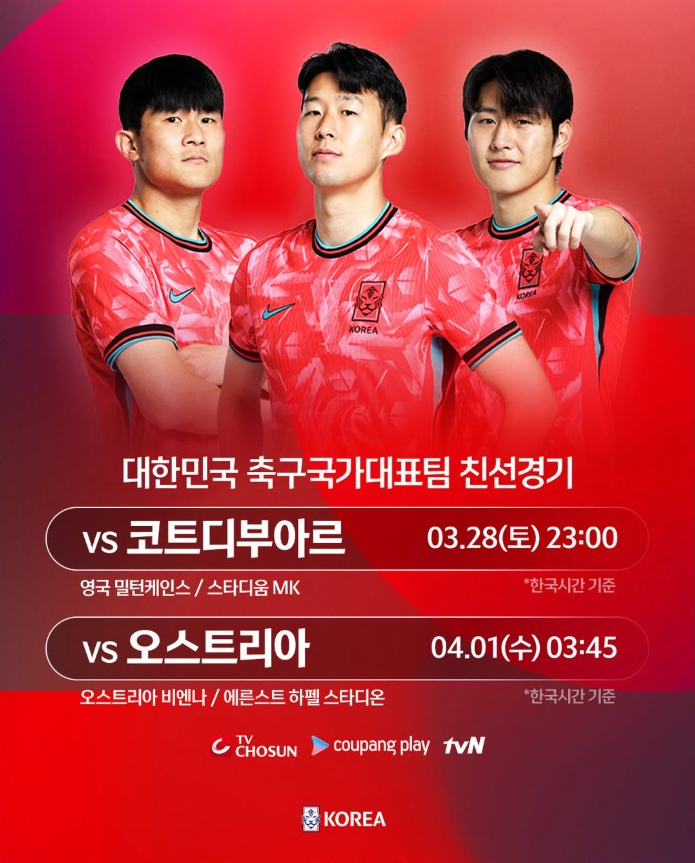 2026년 03월 28일 대한민국 코트디부아르 중계 시청하기
⬇ 2026년 03월 28일 대한민국 코트디부아르 중계시청하기???? https://m.site.naver.com/246i3???? 위치: 영국 밀턴킨스 스타디움 MK (Stad…
2026년 03월 28일 대한민국 코트디부아르 중계 시청하기
⬇ 2026년 03월 28일 대한민국 코트디부아르 중계시청하기???? https://m.site.naver.com/246i3???? 위치: 영국 밀턴킨스 스타디움 MK (Stad…
-
 알고있으면 유익한 생명보험 선택법: Term과 Whole Life 완벽정리
안녕하세요. 1977년부터 미주 한인 사회와 함께하며 대를 이어 고객의 자산을 지켜온 한솔보험입니다. 많은 분이 생명보험 가입을 고려하실 때 가장 먼저 고민하시는 부분이 바로 "…
알고있으면 유익한 생명보험 선택법: Term과 Whole Life 완벽정리
안녕하세요. 1977년부터 미주 한인 사회와 함께하며 대를 이어 고객의 자산을 지켜온 한솔보험입니다. 많은 분이 생명보험 가입을 고려하실 때 가장 먼저 고민하시는 부분이 바로 "…
-
 ICC TV 체널 소개
https://www.youtube.com/channel/UCk3U_4hAIjskbcctBmQKt_Q
ICC TV 체널 소개
https://www.youtube.com/channel/UCk3U_4hAIjskbcctBmQKt_Q
-
 영광셔츠룸 만남★라인:LUP25★영광출장안마★영광오일맛사지★영광노래방★영광유흥업소★영광썸오★
영광셔츠룸 만남★라인:LUP25★영광출장안마★영광오일맛사지★영광노래방★영광유흥업소★영광…
영광셔츠룸 만남★라인:LUP25★영광출장안마★영광오일맛사지★영광노래방★영광유흥업소★영광썸오★
영광셔츠룸 만남★라인:LUP25★영광출장안마★영광오일맛사지★영광노래방★영광유흥업소★영광썸오★영광셔츠룸 만남★라인:LUP25★영광출장안마★영광오일맛사지★영광노래방★영광유흥업소★영광…
-
 강진출장홈타이™20대™라인:LUP25™강진유흥업소™강진룸싸룽™강진여대생출장안마™강진출장만남후기™
강진출장…
강진출장홈타이™20대™라인:LUP25™강진유흥업소™강진룸싸룽™강진여대생출장안마™강진출장만남후기™
강진출장홈타이™20대™라인:LUP25™강진유흥업소™강진룸싸룽™강진여대생출장안마™강진출장만남후기™강진출장…
-
 The heart that tends the flowers Lyrics by Don Kim
 When the sun rises slowly I learn devotion, tend…
The heart that tends the flowers Lyrics by Don Kim
The heart that tends the flowers Lyrics by Don Kim When the sun rises slowly I learn devotion, tend…
-
 트럼프 행정부 이민정책 추방재판 케이스 10배 증가
트럼프 행정부의 강경한 이민 정책 기조 속에서, 최근 추방 케이스는 평년 대비 약 10배까지 증가한 것으로 나타나고 있습니다.2025년에는 단순 서류 미비자에 대한 체포 및 구금…
트럼프 행정부 이민정책 추방재판 케이스 10배 증가
트럼프 행정부의 강경한 이민 정책 기조 속에서, 최근 추방 케이스는 평년 대비 약 10배까지 증가한 것으로 나타나고 있습니다.2025년에는 단순 서류 미비자에 대한 체포 및 구금…
-
 오큐실 이야기: 녹내장·황반변성이 치매와 연결된다고? 눈이 보내는 '뇌'의 SOS 신호 - 오큐실
많은 분들이 녹내장이나 황반변성을 단순한 안과 질환, 즉 '눈의 문제'로만 생각하곤 합니다.하지만 최근 의학계의 연구 결과들은 우리에게 전혀 다른 경고를 보내고 있…
오큐실 이야기: 녹내장·황반변성이 치매와 연결된다고? 눈이 보내는 '뇌'의 SOS 신호 - 오큐실
많은 분들이 녹내장이나 황반변성을 단순한 안과 질환, 즉 '눈의 문제'로만 생각하곤 합니다.하지만 최근 의학계의 연구 결과들은 우리에게 전혀 다른 경고를 보내고 있…
-
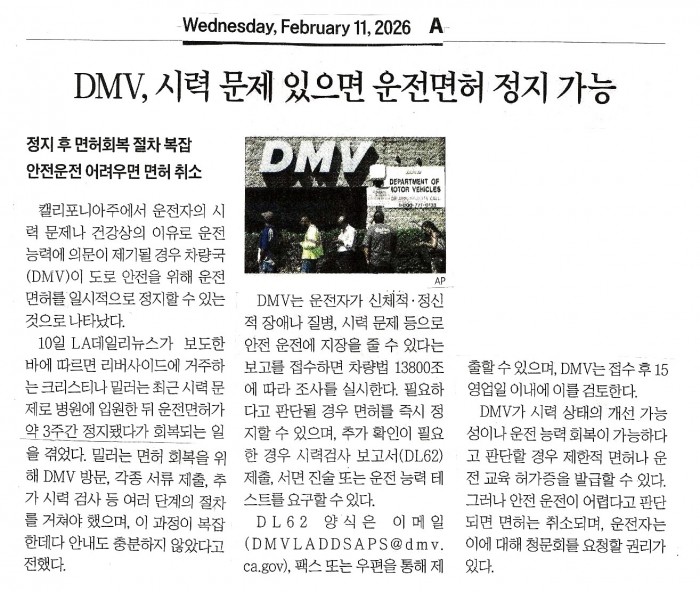 점점 달라지는 자동차 법령
나이를 먹어 가면서 가장 어려운 것은타고 다니는 자동차에 관련된 법령이다.점점 옥죄어 들어오는 과정들이 참으로견디기에는 힘이 들고 여러가지 어려움.나이가 드니 방어 능력도 덩달아…
점점 달라지는 자동차 법령
나이를 먹어 가면서 가장 어려운 것은타고 다니는 자동차에 관련된 법령이다.점점 옥죄어 들어오는 과정들이 참으로견디기에는 힘이 들고 여러가지 어려움.나이가 드니 방어 능력도 덩달아…

Ktown1번가 대표이메일 webinfo@koreatimes.com | 업소록 문의 yp@koreatimes.com
Powered by The Korea Times. Copyright ©The Korea Times All rights reserved.